
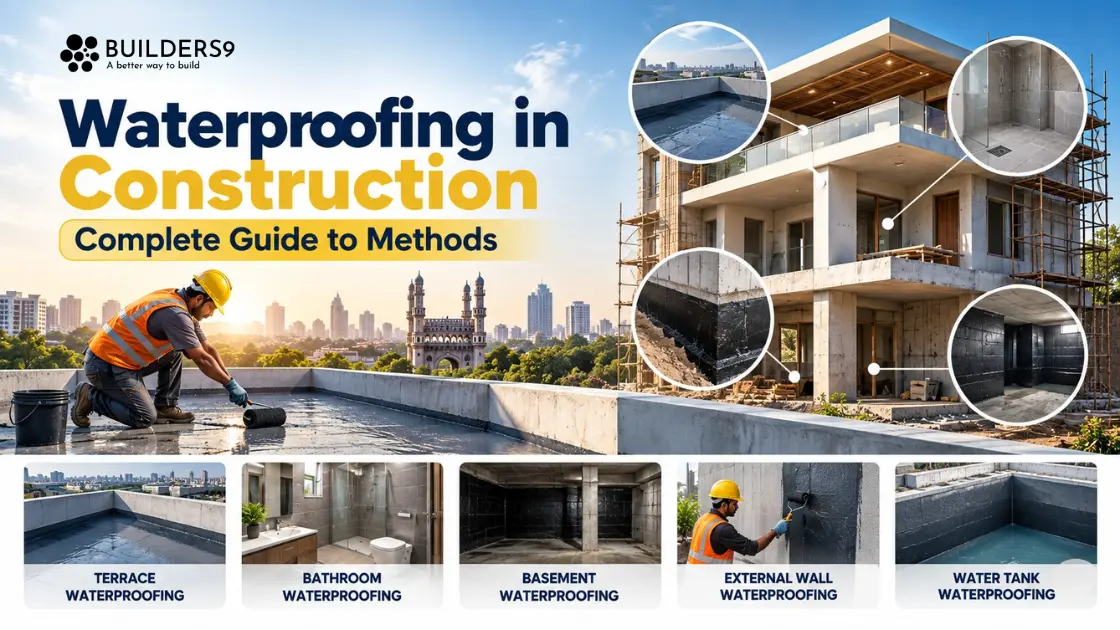
Waterproofing in Construction is one of the most important stages of construction, but it is often treated as something to think about only after a leak appears. In reality, waterproofing in construction should be planned along with the building itself. A terrace, bathroom, basement, external wall, balcony, water tank, or foundation may each require a different waterproofing approach depending on how water reaches the structure.
For homes and buildings in Hyderabad, waterproofing deserves particular attention because construction surfaces experience intense summer heat as well as seasonal rainfall. Flat terraces, balconies, external walls and below-ground areas can face different forms of moisture exposure throughout the year.
This guide explains the major waterproofing methods, materials, applications, planning considerations and common mistakes so homeowners, contractors and builders can make better construction decisions.
What Is Waterproofing in Construction?
Waterproofing is the process of protecting a building or construction element from unwanted water and moisture penetration.
A waterproofing system can involve cementitious treatments, liquid-applied membranes, bituminous coatings, APP or SBS modified bitumen membranes, polyurethane membranes, crystalline waterproofing, waterproofing admixtures, injection grouting, sealants and proper drainage.
The objective is not simply to cover a surface with a chemical. A successful waterproofing system must also consider surface preparation, water drainage, joints, corners, pipe penetrations, cracks, curing and protection of the waterproofing layer.
Why Is Waterproofing Important in Construction?
Water entering a building can initially appear as a small damp patch or paint stain. However, continued moisture exposure can create larger maintenance problems.
Common consequences of water ingress include damp ceilings and walls, peeling paint, efflorescence, mould and unpleasant odours, cracking and surface deterioration, damage around joints and penetrations, corrosion of embedded reinforcement when moisture reaches steel, damage to interior finishes and repeated repair expenses.
Waterproofing is therefore not only about preventing visible leakage. It is also part of protecting building elements from prolonged moisture exposure. For this reason, waterproofing should ideally be considered during the construction planning stage rather than after leakage becomes visible.
Where Is Waterproofing Required in a Building?
Common waterproofing areas include terraces and flat roofs, bathrooms and toilets, balconies, sunken slabs, basements, foundations and plinth areas, external walls, water tanks and sumps, podiums, construction and expansion joints, and areas around plumbing penetrations.
There is no single waterproofing method that is automatically suitable for every location. A terrace may require a membrane system, while a bathroom may be suited to a cementitious coating. Below-ground structures can require additional protection against water pressure.
Major Waterproofing Methods Used in Construction
The most common waterproofing approaches include cementitious waterproofing, liquid-applied membranes, bituminous waterproofing, APP modified bitumen membranes, SBS modified bitumen membranes, polyurethane waterproofing, crystalline waterproofing and injection grouting. The right system depends on the application, substrate, water exposure, movement, detailing and project specification.
1. Cementitious Waterproofing
Cementitious waterproofing uses cement-based materials, often modified with polymers or waterproofing compounds, to create a water-resistant coating.
It is commonly considered for bathrooms, toilets, kitchens, water tanks, wet areas, basements and internal concrete surfaces. One advantage is that cementitious systems can bond well to mineral substrates such as concrete and masonry.
The surface must be properly prepared and the product should be selected according to the application and manufacturer’s technical requirements.
2. Liquid Membrane Waterproofing
Liquid-applied waterproofing systems are applied to a prepared surface and form a continuous membrane after curing. Depending on the product, these systems may be based on acrylic polymers, elastomeric materials, polyurethane or other specialized technologies.
Liquid membranes can be useful on roofs, terraces, balconies and other areas where a continuous waterproofing layer is important. The substrate condition, required thickness, curing conditions and protection requirements should follow the selected system’s technical specification.
3. Bituminous Waterproofing
Bituminous waterproofing uses asphalt-based waterproofing materials to create a protective barrier against water. It may be used in foundations, below-ground structures, terraces, roofs and retaining walls.
Bituminous systems are available in different forms, including coatings and prefabricated membranes. Performance depends not only on the membrane itself but also on correct substrate preparation, overlaps, joints, detailing and protection.
4. APP Modified Bitumen Membrane
APP stands for Atactic Polypropylene. APP-modified bitumen membranes are prefabricated waterproofing sheets designed to provide a continuous waterproofing layer.
They are commonly considered for flat roofs, terraces, basements, foundations and podiums. The membrane must be properly detailed at pipe penetrations, drain outlets, parapet walls, corners, expansion joints and termination points. Water frequently enters through weak points rather than the middle of an otherwise intact membrane.
5. SBS Modified Bitumen Membrane
SBS stands for Styrene-Butadiene-Styrene. SBS-modified membranes are another type of modified bituminous waterproofing system and are designed to provide flexibility and accommodate movement.
Selection between APP, SBS and other systems should depend on the application, substrate, exposure, movement requirements and project specification rather than simply choosing a material based on price.
6. Polyurethane Waterproofing
Polyurethane, commonly called PU waterproofing, is a liquid-applied system that forms a flexible waterproof membrane after curing.
It can be considered for terraces, roofs, balconies, wet areas and exposed concrete surfaces. PU systems are particularly useful where flexibility and continuity of the waterproofing layer are important.
Proper surface preparation is critical. Dust, moisture, weak concrete, contamination and improper application can affect adhesion and overall performance.
7. Crystalline Waterproofing
Crystalline waterproofing uses specialized materials that react within cementitious structures to reduce water movement through capillary pores and pathways.
It may be considered for basements, water tanks, concrete structures, foundations and below-grade structures. Crystalline systems can also be used as part of a broader waterproofing strategy rather than as a universal replacement for membranes.
8. Injection Grouting
Injection grouting is generally used for repairing or controlling water ingress through cracks, joints and specific leakage paths. Depending on the problem, different grout materials may be used.
It can be useful for basement leakage, cracks, construction joints, expansion joints and water-bearing cracks. The source and path of water should be identified before choosing an injection system.
Waterproofing Methods for Different Areas
Terrace Waterproofing
Terraces are among the most exposed parts of a building. They experience direct sunlight, high surface temperatures, rain, standing water, thermal expansion and contraction, and drainage problems.
Common systems can include PU liquid membranes, APP membranes, SBS membranes and cementitious systems. But the waterproofing layer is only one part of terrace protection. Proper slope and drainage are equally important.
For Hyderabad projects, terrace waterproofing should be planned with the local combination of summer heat and seasonal rainfall in mind. Drainage outlets, surface slopes, parapet junctions and penetrations deserve particular attention.
Bathroom and Toilet Waterproofing
Bathrooms are constantly exposed to water. Important areas include bathroom floors, floor-wall junctions, shower areas, pipe penetrations, sunken slabs and drain outlets.
Waterproofing is generally planned before final tile installation, with careful attention to corners and plumbing penetrations. A bathroom can look completely finished while hidden seepage is already damaging surrounding construction, so waterproofing should be treated as an important concealed stage.
Basement Waterproofing
Basement waterproofing is different from terrace waterproofing. A basement can experience water pressure from surrounding soil, especially when groundwater conditions or drainage create hydrostatic pressure against below-ground walls and slabs.
Possible systems include external membranes, integral waterproofing admixtures, crystalline systems, injection grouting and drainage systems. For new construction, waterproofing the external or positive side before backfilling can provide an important layer of protection.
External Wall Waterproofing
External walls can be affected by driving rain, cracks, poor joints, unsealed openings, damaged exterior finishes and water entering around windows.
Depending on the wall condition, waterproof coatings, sealants or other systems may be considered. However, internal dampness does not always mean the terrace is responsible. The source of moisture should be identified before selecting a treatment.
Waterproofing During Construction vs Waterproofing After Leakage
Planning waterproofing during construction allows the project team to address slopes, drainage, construction joints, pipe penetrations, expansion joints and foundation protection before finishes conceal these areas.
Once a building develops leakage, identifying the actual source can become more difficult. The visible damp patch may not be directly below the point where water entered. Prevention and proper detailing during construction can therefore reduce the risk of repeated remedial work.
Common Waterproofing Mistakes to Avoid
1. Applying waterproofing over an unprepared surface. Dust, loose particles, weak concrete, old coatings or contamination can interfere with adhesion.
2. Ignoring drainage. Waterproofing does not replace proper drainage. Terraces and balconies should have suitable slopes and functioning outlets.
3. Ignoring pipe penetrations. Plumbing penetrations are common leakage points and require appropriate detailing.
4. Treating cracks without understanding them. A crack may be structural, shrinkage-related or associated with movement.
5. Covering waterproofing too quickly. Some systems require adequate curing, testing and protection before tiles, screed or other layers are installed.
6. Choosing a method only because it is cheaper. A failed waterproofing system can lead to removal of finishes, repainting, leakage repairs, reapplication, labour costs and disruption.
How to Check Waterproofing Quality Before Finishing
Before waterproofing is concealed, check the surface preparation, coverage, required thickness, joints, pipe penetrations, drainage and appropriate water testing where applicable.
Also check whether subsequent construction activities could damage the waterproofing layer. These checks are important because waterproofing often becomes inaccessible after tiles, screed, soil, finishes or other layers are installed.
Waterproofing in Hyderabad What Homeowners Should Consider
For a Hyderabad construction project, waterproofing planning should consider the combination of summer heat, seasonal rainfall and exposed flat-roof construction.
Areas that deserve particular attention include terraces, balconies, bathrooms, external walls, sunshades, basements, plinth areas, water tanks and drainage outlets.
For new construction, waterproofing requirements should be included in the project plan from the relevant construction stage rather than added only after leakage appears.
How to Choose the Right Waterproofing Method
There is no single waterproofing method that is best for every building. Consider the location, water exposure, surface condition, movement, drainage, protection requirements and maintenance.
The right solution is therefore a combination of material, application method, detailing, drainage and workmanship.
Waterproofing Materials and Construction Planning
For a new house, waterproofing should not be treated as an isolated purchase. It should be coordinated with cement, sand, aggregates, concrete, plumbing, tiles, screed, drainage materials, sealants, waterproofing compounds and finishing materials.
A typical sequence may be: RCC slab → surface preparation → slope and drainage → waterproofing → testing → protection or screed → tiles or final finish.
The exact sequence depends on the waterproofing system and project specification.
Why Material Planning Matters for Waterproofing
Waterproofing failures are not always caused by the wrong product. Sometimes the problem is poor coordination.
Plumbing work may damage a finished waterproofing layer. Tiles may be installed before testing. Drain outlets may not be coordinated. Waterproofing may be covered before adequate curing. Other site activities may puncture a membrane.
For homeowners and contractors in Hyderabad, planned construction-material procurement can help reduce last-minute material issues and coordinate different stages of work.
Waterproofing Checklist for House Construction
☐ Identify every area requiring waterproofing
☐ Check the substrate condition
☐ Plan terrace and balcony slopes
☐ Check drainage outlets
☐ Coordinate plumbing penetrations
☐ Identify construction and expansion joints
☐ Select the appropriate waterproofing system
☐ Follow the manufacturer’s application requirements
☐ Allow adequate curing time
☐ Conduct appropriate water testing
☐ Inspect before covering the waterproofing
☐ Protect the completed waterproofing from site damage
☐ Maintain records of the system used
Frequently Asked Questions About Waterproofing in Construction
What is waterproofing in construction?
Waterproofing is the process of protecting building elements from unwanted water and moisture penetration using suitable materials, membranes, coatings, detailing and drainage systems.
Which waterproofing method is best for a terrace?
There is no universal best method. PU liquid membranes, APP or SBS membranes and other systems may be suitable depending on terrace condition, exposure, drainage, movement and project requirements.
Is waterproofing necessary for a new house?
Waterproofing should be considered during construction, particularly for terraces, bathrooms, balconies, foundations, basements, water tanks and other areas exposed to moisture.
Is bathroom waterproofing necessary before tiles?
Waterproofing is generally planned before the final tile layer so that the waterproofing system can protect the underlying construction. Proper detailing around corners, joints and plumbing penetrations is also important.
Is terrace waterproofing important in Hyderabad?
Hyderabad’s combination of strong summer heat and seasonal rainfall makes terrace drainage and waterproofing important considerations for residential and commercial buildings.
Can waterproofing be done after leakage starts?
Yes, remedial waterproofing is possible, but the source of water ingress should first be identified. Depending on the situation, repairs may involve crack treatment, injection grouting, membrane replacement or another suitable system.
How long does waterproofing last?
There is no single lifespan applicable to every waterproofing system. Durability depends on the material, application quality, substrate preparation, exposure, drainage, protection and maintenance.
Final Thoughts
Waterproofing in construction is not simply about stopping a leak. It is about planning how a building will deal with water before water becomes a problem.
The right waterproofing approach depends on where it is being applied, how the surface is exposed to water, the condition of the substrate, drainage, movement, detailing and the construction sequence.
For a house or commercial project in Hyderabad, waterproofing should be considered from the planning stage, especially for terraces, bathrooms, balconies, external walls, basements and foundations.
At Builders9, construction material planning is about helping homeowners, contractors and builders manage the materials required across different stages of construction. From cement, TMT steel, sand and aggregates to bricks, AAC blocks, plumbing, electrical and finishing materials, having the right materials planned at the right stage can make construction more organized.