
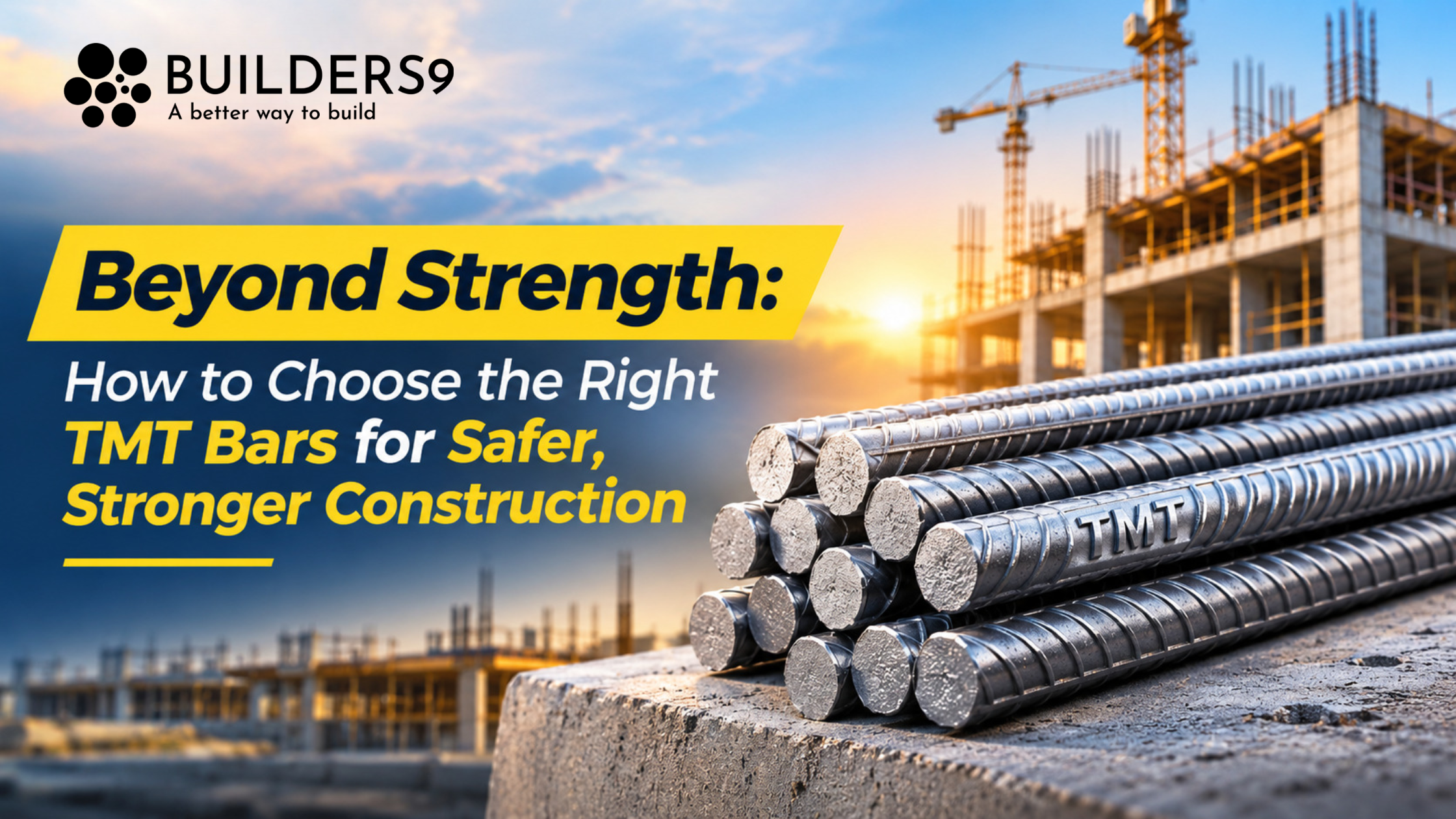
TMT bars are a critical part of reinforced-concrete construction. A building may be admired for its elevation, flooring, paint and architectural design, but much of its structural performance depends on materials that remain hidden inside concrete. Thermo-mechanically treated (TMT) bars are used as reinforcement in elements such as foundations, columns, beams and slabs. They work together with concrete to help a structure resist the forces considered in its engineering design.
For homeowners, builders, contractors and project managers, choosing TMT bars is therefore an important purchasing decision. It should not be based only on the lowest price per kilogram, a familiar brand name or the assumption that the highest grade is always the best. The appropriate product depends on the structural drawings, specified grade and diameter, applicable standards, documentation, site conditions and quality of supply.
This guide explains the role of TMT bars, common grade designations, the importance of ductility, practical inspection points and questions to ask before placing an order. It is intended to help buyers have a more informed discussion with their structural engineer and material supplier.
1. What Are TMT Bars?
TMT stands for thermo-mechanically treated. TMT bars are reinforcement steel bars manufactured through a controlled process involving heating, rolling and rapid surface cooling, followed by further cooling. This process is designed to create a combination of properties across the bar, including a strong outer surface and a comparatively more ductile inner core. The final mechanical properties depend on the manufacturing process, raw materials and quality controls followed by the producer.
The surface of a TMT bar usually has ribs or deformations. These help create a mechanical bond between the steel and the surrounding concrete. A good bond allows the two materials to work together as a reinforced-concrete system. Concrete is strong in compression, while steel reinforcement helps the structural member resist tensile forces. The engineer designs the arrangement of concrete and reinforcement according to the loads and conditions expected for the project.
TMT bars are commonly used in reinforced-concrete foundations, columns, beams, slabs, retaining structures and other engineered applications. Their use does not make a structure safe by itself: correct structural design, suitable concrete, proper reinforcement detailing, workmanship, curing and site supervision are also essential.
2. Understand TMT Bar Grades Before Buying
In India, high-strength deformed steel bars and wires used for concrete reinforcement are covered by Bureau of Indian Standards specification IS 1786. Common grade designations include Fe 415, Fe 500, Fe 550 and Fe 600, along with ductility-designated variants such as Fe 500D. The grade designation communicates specified mechanical-property requirements, including yield strength.
The number in a grade designation is associated with the specified minimum yield strength expressed in newtons per square millimetre (N/mm²). The letter “D” in a designation such as Fe 500D indicates a ductility-related variant with additional requirements. Buyers should check the precise product designation and relevant standard rather than relying on a shorthand description in a sales conversation.
A higher grade is not automatically the right choice for every building. The structural engineer selects the grade based on design requirements and applicable codes. The grade, bar diameter, spacing, lap length, anchorage and detailing must match the approved structural drawings. Substituting a different grade or diameter without approval can affect design assumptions and construction details.
Before ordering, ask the supplier to state the grade clearly on the quotation and invoice. Confirm that the grade delivered matches the structural specification and the product documentation. If there is any mismatch, pause the installation and ask the project’s structural engineer to review it.
3. Why Ductility Is as Important as Strength
Strength and ductility describe different material properties. Strength relates to the stress a material can withstand, while ductility describes its ability to deform before fracture. In structural applications, controlled deformation can be important because buildings may experience changing loads during their service life. A reinforcement bar should meet the mechanical requirements specified for the intended application.
Ductility is one of the reasons engineers may specify a particular grade variant rather than choosing reinforcement only by its strength value. Under certain loading conditions, a ductile material can deform before failure, providing a different response from a material that fails with little deformation. The required properties must be considered as part of the overall structural design.
For projects in areas where earthquake effects are a design consideration, follow the structural engineer’s design and relevant Indian standards and codes. Do not assume that buying a product labelled “earthquake resistant” or selecting a higher grade can replace correct engineering. Structural configuration, detailing, connections, construction quality and compliance with the design all matter.
4. How to Check TMT Bar Quality Before Purchase
A buyer can carry out several practical checks before accepting a delivery. These checks help confirm that the material supplied is consistent with the order, but they do not replace laboratory testing or professional assessment where those are required.
- Verify the applicable BIS marking and licence details. Check the product marking and documentation for the relevant standard. Where applicable, verify the manufacturer’s licence details using official BIS resources. Ask for a proper invoice and keep the product and batch information on record.
- Confirm the grade and diameter. Compare the grade and nominal diameter printed or marked on the supplied material and shown in the documents with the structural drawings and purchase order. Do not rely only on a verbal assurance.
- Inspect the bars visually. Look for serious surface defects, cracks, deep corrosion, excessive pitting, bending damage or other visible issues. Surface appearance alone cannot establish the full mechanical quality of a bar, so raise concerns with the supplier and project engineer.
- Check quantity and weight. Compare the delivered quantity and nominal mass per metre with the purchase documents and relevant specification. For bulk deliveries, use an appropriate calibrated weighing process and maintain delivery records.
- Ask for relevant test documentation. Where required by the project or purchase terms, request the manufacturer’s test certificate or mill test certificate. Check that the grade, size and batch details correspond to the supplied material.
- Maintain traceability. Keep invoices, delivery challans, batch details and test documents together. Traceability makes it easier to investigate a quality concern and confirm which material was delivered to a particular site.
- Store reinforcement correctly. Keep bars organised and supported off the ground where practical. Avoid prolonged contact with standing water, mud, oils and other contaminants. Follow the site engineer’s instructions for storage, handling and preparation before use.
5. Common TMT Bar Buying Mistakes to Avoid
One common mistake is choosing a product only because its quoted price is lower. A meaningful comparison should consider the grade, diameter, manufacturer, applicable standard, documentation, quantity, taxes, transport and delivery conditions. A low headline price may not represent the same product or service as another quotation.
Another mistake is assuming that all products with the same grade designation are identical in every respect. Buyers should verify the manufacturer, product marking, relevant standard compliance and batch documentation. A grade name is important, but it is not a substitute for checking the actual product and its supporting records.
Some sites make last-minute substitutions when a particular diameter or grade is unavailable. This should not be done casually. Reinforcement size, spacing and grade are part of the structural design. Any proposed change should be reviewed and approved by the structural engineer before the material is installed.
Poor storage and handling can also create avoidable problems. Bars left in unsuitable conditions may become contaminated or develop corrosion. Keep the site organised, inspect deliveries and follow the project’s storage instructions. Finally, avoid accepting mixed or poorly documented batches without confirming what has been supplied.
6. How to Select the Right TMT Bars for Your Project
Begin with the latest approved structural drawings and the bar-bending schedule prepared or approved by the project team. These documents help identify the required grade, diameter, shape, length and quantity. If the drawings or schedule are unclear, ask the engineer or contractor to clarify the requirement before requesting quotations.
Prepare a purchase enquiry that lists the required grade and diameters, approximate quantities, delivery location, expected delivery schedule and documentation requirements. Ask each supplier to quote on the same basis. This makes it easier to compare offers fairly and reduces the risk of selecting a quotation that excludes transport, taxes or other costs.
For larger projects, plan deliveries in stages according to construction progress and available storage space. Ordering too early may create storage and handling challenges, while ordering too late can interrupt planned work. Coordinate procurement with the site team so that the required materials arrive in time for the approved construction sequence.
When the material reaches the site, compare it with the purchase order before unloading or installation. Record the quantity and batch information, retain the invoice and certificates, and report any discrepancy promptly. A consistent receiving process helps maintain quality records throughout the project.
7. What Influences TMT Bar Prices?
TMT bar prices can change over time and may differ between suppliers and locations. Factors that can influence a quotation include the cost of raw materials, manufacturing and energy costs, market demand, grade, diameter, brand, order quantity, freight, taxes and local availability. Prices may also vary according to the terms of payment and delivery.
For this reason, an online price or an old quotation should not be treated as a guaranteed current rate. Ask for a fresh, written quotation that states the product details, price basis, taxes, transport charges and validity period. Compare like-for-like specifications rather than comparing only the final number.
For a project budget, discuss the estimated steel quantity with the project engineer or quantity surveyor. Allow for the quantities and cutting or bending requirements shown in the approved schedule. Do not reduce the specified reinforcement simply to lower the material bill; any design change must be evaluated and approved by the qualified professional responsible for the structure.
8. Steel Industry Developments and Responsible Buying
India’s steel sector is closely connected to housing, infrastructure, manufacturing and construction activity. Changes in production capacity, demand, input costs and logistics can influence the market environment in which construction materials are purchased. National production or consumption trends provide context, but they cannot predict the price or availability of a specific TMT product in a particular city or on a particular date.
There is also increasing attention on the environmental impact of industrial production, including steelmaking. Government initiatives and certification frameworks relating to lower-emission or green steel are developments that buyers may encounter in the market. If environmental performance is important to a project, ask suppliers for the relevant certification and supporting documentation. Do not treat a marketing description such as “green steel” as proof of certification without checking the evidence.
For any product, the core purchasing checks remain important: confirm the required grade, standard compliance, mechanical properties, traceability and suitability for the engineer’s design. Environmental credentials can be an additional consideration, but they do not replace structural requirements.
9. Questions to Ask Your TMT Bar Supplier
- What manufacturer and grade are being quoted, and does the product match the structural specification?
- Which nominal diameters and quantities are available for the required delivery schedule?
- What applicable BIS marking and product documentation can be provided?
- Can the supplier provide batch details and relevant test certificates where required?
- Are transport, unloading, taxes and other charges included in the quotation?
- How long is the quoted price valid, and what are the payment and delivery terms?
- What is the process if the delivered material does not match the purchase order?
Asking these questions helps create a clear record of what has been ordered and what the supplier has agreed to deliver. Keep the quotation, purchase order, invoice and delivery documents together for future reference.
10. Build with Confidence with Builders9
A successful construction project depends on many connected decisions, from planning and engineering to material selection, delivery and workmanship. TMT bars are an important part of reinforced-concrete construction, but the right choice is always the one that matches the approved structural design and applicable requirements.
Whether you are planning a new home, managing a construction site or sourcing materials for a larger project, take time to check the grade, diameter, documentation and delivery terms before purchasing. Work with your structural engineer and choose a supplier who can clearly communicate product details and order conditions.
Builders9 aims to make construction material sourcing more convenient by bringing essential building materials together in one place. Explore material options and plan your next project with Builders9.
Builders9 – A Better Way to Build.
Website: https://builders9.com
Phone: +91 73967 77235
Frequently Asked Questions About TMT Bars
What are TMT bars used for?
TMT bars are used as reinforcement in reinforced-concrete elements such as foundations, columns, beams and slabs. The structural engineer specifies the grade, diameter, spacing and detailing for the project.
What is the difference between Fe 500 and Fe 500D TMT bars?
Both are grade designations under the relevant reinforcement-steel specification. The “D” variant includes additional ductility-related requirements. The grade required for a project must be selected by the structural engineer.
Are thicker TMT bars always better?
A larger diameter contains more steel area, but diameter alone does not determine suitability. Grade, spacing, detailing and the structural design all matter. Follow the approved drawings.
Can I use a higher TMT grade than the one shown in my drawings?
Do not make this change independently. A different grade can affect design assumptions and detailing. Obtain approval from the structural engineer before substituting materials.
How can I check TMT bar quality?
Check applicable BIS marking and licence details, grade and diameter markings, invoice, batch traceability and relevant test documentation. Visual inspection alone cannot establish all mechanical properties.
Does surface rust mean TMT bars cannot be used?
Not every surface discolouration has the same significance. Deep corrosion, pitting or loss of section requires assessment. Follow the project engineer’s instructions and applicable site-quality requirements.
Should I choose TMT bars based only on price?
No. Compare grade, diameter, manufacturer, standard compliance, documentation, quantity, transport and delivery terms. Make sure the product matches the engineer’s specification.