
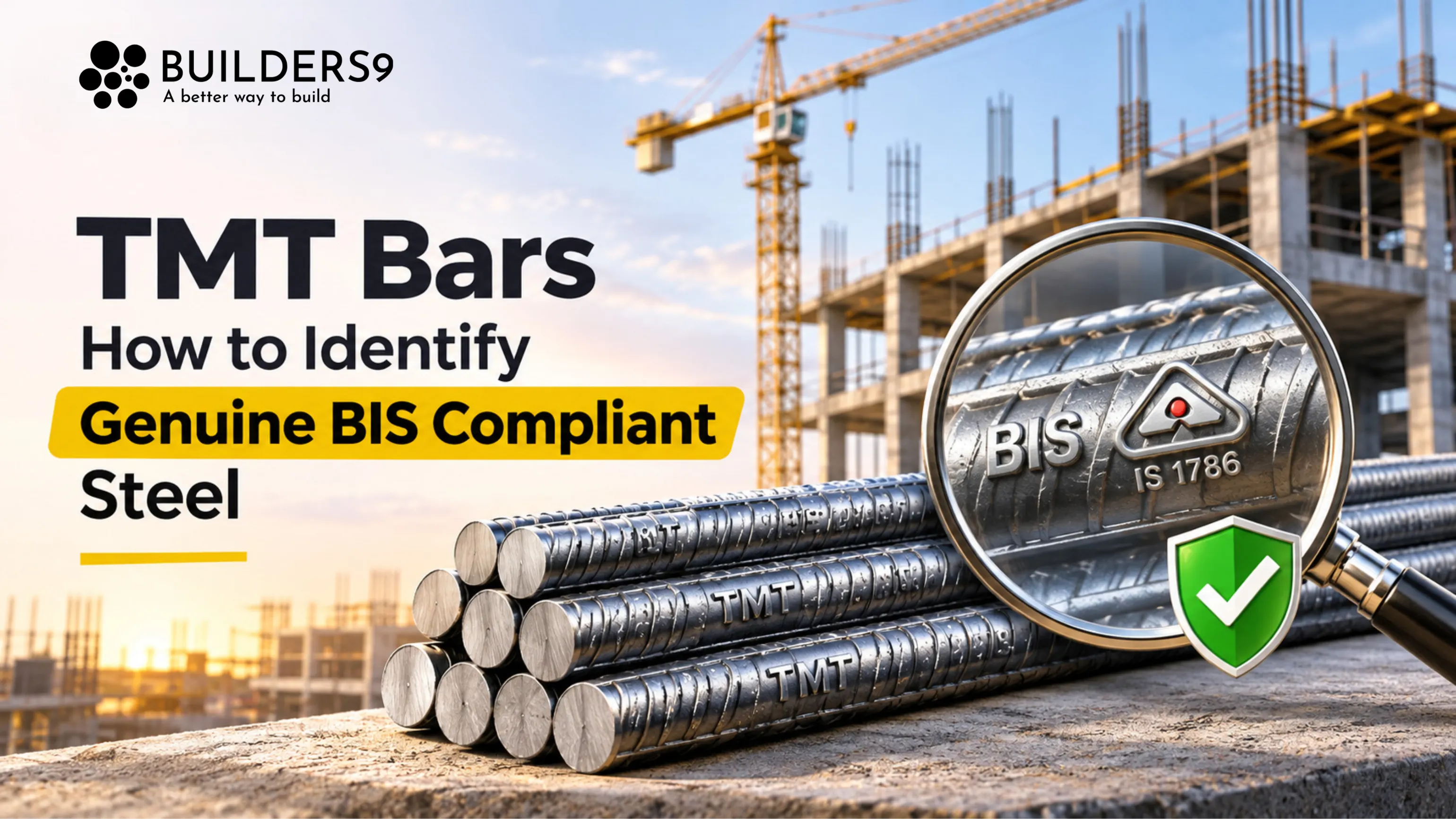
TMT Bars are among the most important materials used in reinforced concrete construction. They help concrete structures resist tensile forces and are commonly used in foundations, columns, beams, slabs and other structural members. Because reinforcement becomes part of the building, choosing it deserves more attention than simply comparing prices or selecting the first available brand.
When you plan a house, commercial building or renovation, you should know what you are buying and how to verify the product information. In India, high-strength deformed steel bars and wires for concrete reinforcement are covered by Indian Standard IS 1786. The Bureau of Indian Standards, commonly known as BIS, operates a product certification system that allows consumers to verify licence details and check whether a product is covered by a valid certification scope.
This guide explains how to identify genuine BIS-compliant TMT steel, what to inspect on the bars and bundle, how to use the BIS CARE app, and which documents to request before accepting a delivery. The aim is to help homeowners, contractors and builders make informed purchasing decisions. A visual check is useful, but it cannot replace laboratory testing or the advice of a qualified structural engineer.
Why BIS Compliance Matters When Buying TMT Bars
A BIS Standard is a documented set of technical requirements for a product. IS 1786:2008 covers high-strength deformed steel bars and wires for concrete reinforcement. It sets requirements and test methods for product characteristics, including mechanical properties and physical checks. BIS lists IS 1786:2008 among products covered under its compulsory certification framework.
For buyers, checking the BIS Standard Mark and licence details is an important step towards traceability. It gives you a way to verify the manufacturer, check whether the licence is current, and confirm whether the product being offered falls within the licence scope. This is more reliable than depending only on a printed claim, a familiar-looking logo, a brochure or a salesperson’s verbal assurance.
Certification should not be misunderstood as a promise that a buyer never needs to inspect a delivery. You should still match the product details, batch or cast information and test certificate to the actual consignment. The grade and bar size must also match the structural drawings and specifications approved by your engineer. A product can be certified, yet still be the wrong grade or diameter for a particular project if it does not match the design.
Understand the ISI Mark and IS 1786
The Standard Mark is commonly known as the ISI mark. For reinforcement steel, seeing a mark on a package or in a catalogue is only the beginning of verification. Check the licence details through an official BIS route and confirm that the product category and licence scope correspond to the steel being supplied.
IS 1786:2008 is titled High Strength Deformed Steel Bars and Wires for Concrete Reinforcement. BIS product documentation identifies checks such as freedom from defects, deformation and surface characteristics, nominal size, effective cross-sectional area and mass, proof stress, percentage elongation, tensile strength, bend and rebend tests. These checks matter because steel performance cannot be established by appearance alone.
Different grades, sizes and product varieties may be included in a manufacturer’s licence scope. Therefore, do not assume that a valid licence for one product range automatically covers every grade, diameter, brand or variety sold by the same company. Verify the exact scope relevant to the material you intend to purchase. If the information is unclear, ask the manufacturer or supplier for clarification before placing the order.
How to Verify TMT Bars Using the BIS CARE App
One practical way to verify a BIS Standard Mark is through the official BIS CARE app. BIS states that the app includes a Verify Licence Details feature for checking the authenticity of products carrying the Standard Mark. The app is available for Android and iOS. Its official listing describes checking information such as the manufacturer’s name and address, licence validity, varieties covered by the licence, brands included and current licence status.
Follow these steps before confirming your purchase:
Find the BIS licence number associated with the Standard Mark. It may appear on the bundle tag, product label or relevant product marking. Make sure you copy the number accurately.
Install the BIS CARE app published by the Bureau of Indian Standards. Check the publisher name so that you do not accidentally use an unrelated app with a similar title.
Open the app and select Verify Licence Details. Enter the licence number exactly as it appears on the product or its documentation.
Review the result. Confirm that the manufacturer name and address match the information supplied by the seller and printed on the product documents.
Check the licence status and validity shown in the official result. A past certificate or an old screenshot does not establish that a licence is currently valid.
Review the scope of the licence. Confirm that it covers the relevant product and the grade, size, brand or variety where these are listed in the scope.
Keep a record of the verification with your purchase documents. Repeat the check if a later delivery comes from a different manufacturer or carries a different licence number.
If the app does not return a matching result, the details are inconsistent, or the licence appears invalid or outside its scope, pause the purchase and ask the seller or manufacturer for clarification. Do not treat a screenshot supplied by a salesperson as a substitute for checking the licence yourself. You can also consult the official BIS website and use its published contact channels if a concern remains unresolved.
Check the Markings on the TMT Bars
BIS documentation for IS 1786 includes requirements for permanent identification on bars or wires. The BIS product manual specifies that the manufacturer’s brand name or trademark, the grade, and a six-digit identification number are to be marked during rolling or by another permanent method at intervals not exceeding three metres. The six-digit identification number is linked to the BIS branch and the last four digits of the manufacturer’s licence number.
When inspecting a delivery, look for clear and consistent markings along the bars. Check that the manufacturer identity and grade are legible. Compare the identification number with the licence information and the details on the bundle tag or test certificate. If markings are missing, unclear, inconsistent or appear altered, ask the supplier to explain before accepting the material.
Do not make a decision from one marking alone. A copied or misleading mark can appear on packaging, and the bar’s appearance cannot prove that a licence is valid. Use the markings as one part of a wider verification process that includes the BIS CARE app, bundle label, invoice and test certificate. Keep the material traceable to the manufacturer and batch throughout storage and use.
Examine the Bundle Tag and Purchase Documents
The bundle tag or label connects the physical material with the manufacturer and consignment information. Before unloading or signing off a delivery, review the tag and compare it with your purchase order, invoice and delivery challan.
Look for the manufacturer or brand name, grade, nominal diameter or size, quantity or bundle information, cast or heat number, and BIS licence details where provided. The exact format can vary by manufacturer, so use the applicable standard and supplier documentation as your reference. The key point is consistency: the details should match across the bar markings, tag, invoice and test certificate.
Ask for the test certificate for the supplied consignment. The BIS product manual includes a test certificate format for IS 1786 material. It identifies information such as the order reference, nominal size, cast or heat number, quantity, date of testing, chemical analysis and mechanical test results. It also refers to the Standard Mark and applicable licence information.
A certificate should relate to the material you actually received. Check whether the grade, size, cast or lot number and quantity correspond with the bundle and delivery documents. If the certificate is generic, incomplete or relates to a different batch, request the correct document. Keep copies of the invoice, delivery challan, bundle tag and test certificate together. This paper trail can be valuable if questions arise during site quality checks.
Understand the TMT Grade Before You Buy
TMT bars are sold in different grades, and the grade is not just a label. It represents specified mechanical properties under the applicable standard. IS 1786 includes multiple grades, such as Fe 415, Fe 500 and Fe 550, along with specified variants and other grades. The exact grade available and covered by a manufacturer’s licence must be verified rather than assumed.
A higher grade number does not automatically mean that it is the right choice for every part of a building. Structural design involves more than selecting the highest number on a product label. The engineer considers loads, spans, member dimensions, reinforcement detailing, ductility requirements, seismic considerations, construction conditions and applicable design codes.
Before placing an order, refer to the structural drawings and bar bending schedule prepared or approved by your structural engineer. Ask the supplier to quote the exact grade and diameter specified. Do not allow a substitution based only on availability, brand preference or a price difference without written approval from the engineer. This is particularly important when several grades are being used across different structural elements.
Visual Quality Checks You Can Make at the Site
A site-level visual inspection can help identify obvious problems, but it cannot certify the mechanical properties of steel. Treat it as an initial screening step, not proof of BIS compliance.
Check that the bars are reasonably straight and do not show severe bends, cracks, splits, laminations or other visible defects. Look for excessive flaky rust, deep pitting or heavy scale. Light surface rust may occur during storage and transport, but deep corrosion and loss of section need professional assessment. If you are unsure, ask the site engineer or quality-control professional to inspect the material before use.
Check that the ribs or deformations appear consistent and that the bars have not been visibly damaged during handling. Confirm the nominal diameter and length against the order. Where required, the site team can arrange measurement and testing using suitable equipment and approved procedures.
Avoid relying on informal tests such as striking a bar, judging its sound, bending it by hand or using a magnet. These methods do not establish compliance with IS 1786 and cannot replace prescribed tests. Mechanical properties such as proof stress, tensile strength and elongation require appropriate testing. If a bar looks unusual, isolate it and ask the quality-control team to assess it rather than trying to decide its suitability through a quick site trick.
Why Laboratory Tests and Test Certificates Matter
The performance of reinforcement steel depends on properties that cannot be reliably judged by looking at a bar. The IS 1786 framework includes tests for mechanical properties and other characteristics. BIS product documentation identifies proof stress, tensile strength, percentage elongation, bend and rebend tests among the checks used to assess conformity.
For a large project, a project with strict quality-control requirements, or a consignment that raises concerns, the owner or contractor may arrange independent testing through a competent laboratory. The sampling method, test method and acceptance criteria should follow the applicable standard, contract specifications and instructions from the project’s quality-control team. Do not cut random samples or send them for testing without maintaining traceability to the delivered batch.
A test report is useful only when it can be linked to the material being used. Record the supplier, manufacturer, grade, diameter, cast or heat number, delivery date and sample identification. If a test result is unsatisfactory, segregate the affected material and seek advice from the engineer and quality-control team before using it. Do not mix questioned material with approved stock.
Common Mistakes to Avoid When Purchasing TMT Bars
Choosing the lowest quotation without checking the manufacturer, grade and licence scope can create avoidable risk. Price matters, but it should be compared only after confirming that the quoted products meet the project specification. Compare equivalent grades, diameters, quantities, documentation and delivery terms rather than comparing two prices without checking what each includes.
Another common mistake is checking the ISI mark but not verifying the licence number. A mark displayed in a brochure or on a tag is not enough on its own. Use the BIS CARE app or official BIS information to verify the licence and its current status.
Buyers sometimes assume that all grades and diameters from a manufacturer are covered by one licence. The licence scope must be checked for the particular product range. Similarly, do not accept a test certificate that does not match the cast or lot, grade and size of the delivered material.
Avoid mixing unidentified bars from different manufacturers or batches at the site. Keep materials separated and labelled until the site team has completed the required checks. Do not accept substitutions without approval from the structural engineer. Finally, do not store reinforcement directly on wet soil or in conditions that encourage avoidable deterioration. Follow the site engineer’s storage and handling instructions and maintain batch identity during storage.
A Practical TMT Bars Buying Checklist
Before confirming the order, use this practical checklist:
Confirm the grade and diameter against the structural drawings and bar bending schedule.
Ask for the manufacturer’s name and BIS licence number.
Verify the licence through the official BIS CARE app using Verify Licence Details.
Check that the licence is valid and covers the product, grade, size and relevant brand or variety.
Inspect permanent bar markings for manufacturer identity, grade and identification number.
Match the bundle tag with the bar markings and purchase documents.
Request the test certificate for the actual consignment.
Match the cast or heat number, grade, size and quantity across the certificate and delivery.
Inspect the bars for obvious physical damage or severe corrosion.
Keep the invoice, delivery challan, licence verification record and test certificate on file.
Seek independent testing or professional inspection if the project specification requires it or if any inconsistency is found.
This checklist is designed to help buyers ask the right questions. It does not replace the full requirements of IS 1786, project specifications, laboratory testing or engineering approval. Use it as a procurement aid alongside the quality-control process followed at your site.
How Builders9 Can Help You Source Construction Materials
Finding the right construction materials is easier when product requirements are clear before ordering. Builders9 helps customers source essential construction materials for building projects, including TMT bars and other commonly used materials such as cement, sand, aggregates, bricks and AAC blocks.
When discussing a TMT bars requirement, share the grade, diameter, estimated quantity and delivery location. If your engineer has specified a particular manufacturer or product, communicate that clearly. Ask for the relevant product and delivery documents, and verify the BIS licence details independently before accepting the material. Availability, brand options and delivery timelines should be confirmed at the time of ordering.
Builders9’s role is to make construction-material sourcing more convenient. The final selection of reinforcement grade, size and design suitability should always remain with the project’s structural engineer. A well-planned purchase combines the right technical specification, clear documentation and a dependable supply process.
For your next construction project, speak with Builders9 about your material requirements and plan your procurement with greater clarity. Share your approved specifications, compare suitable options and confirm the documentation before the material is put to use. Builders9 — A Better Way to Build.
Frequently Asked Questions About BIS Compliant TMT Bars
What is the BIS standard for TMT bars in India? High-strength deformed steel bars and wires for concrete reinforcement are covered by IS 1786:2008. Check the current BIS product-specific information and applicable amendments when verifying requirements.
How can I check whether TMT bars are BIS certified? Find the BIS licence number associated with the Standard Mark and use the official BIS CARE app’s Verify Licence Details feature. Confirm the manufacturer, licence status and scope. Match the result with the product and documents supplied.
Is seeing the ISI mark enough to confirm genuine TMT bars? No. Treat the mark as a starting point. Verify the licence number through BIS and check that the licence scope covers the product, grade and size you are buying. Also inspect the bar markings, bundle tag and test certificate.
What details should be marked on TMT bars? BIS product documentation for IS 1786 specifies permanent identification that includes the manufacturer’s brand or trademark, the grade and a six-digit identification number at intervals not exceeding three metres. Check the latest applicable BIS documentation for the exact requirements.
What is a TMT bar test certificate? It is a document recording details and test results for the supplied material. The BIS product manual’s format includes information such as grade, size, cast or heat number, quantity, chemical analysis and mechanical properties. Make sure the certificate corresponds to the batch delivered.
Can I identify genuine TMT bars by colour or weight alone? No. Colour, surface appearance or a quick weight check cannot establish BIS certification or mechanical performance. Use official licence verification and traceable product documents. Arrange appropriate testing when required.
Should I choose Fe 500 or Fe 550 TMT bars? The right grade depends on the structural design and project requirements. Follow the grade specified by your structural engineer. Do not select a grade only because its number is higher or its price is lower.
Does BIS certification mean the steel will never corrode? No. BIS certification does not mean that reinforcement steel is immune to corrosion. Corrosion risk depends on exposure, concrete quality, cover, workmanship, detailing and maintenance, among other factors. Follow the structural design and site specifications for durability.
What should I do if the BIS CARE app details do not match the product? Pause acceptance or use of the material. Ask the supplier and manufacturer for clarification and supporting documents. If the mismatch remains unresolved, contact BIS through its official channels and consult the project quality-control team.
Who should approve the TMT grade and diameter for a building? The structural engineer responsible for the design should specify or approve the grade and diameter. A supplier can help source the specified product, but should not replace engineering judgement.
Conclusion
TMT Bars play a critical role in reinforced concrete construction, so buyers should look beyond price and appearance. A careful purchase begins with the grade and diameter specified by the structural engineer, followed by verification of the BIS licence, inspection of permanent markings, review of bundle details and checking of the test certificate.
Use the BIS CARE app to verify licence details, make sure the scope matches the product you are buying, and keep all consignment documents together. If anything is unclear, pause and seek clarification rather than relying on assumptions. These practical steps can help homeowners, contractors and builders make better-informed material decisions.
For construction material sourcing, connect with Builders9 and discuss your project requirements. Choose the right specification, verify the documents and build with confidence. Builders9 — A Better Way to Build.